
What Kicks In When Something Breaks
How a problem solving mode became a folk-metaphysics that shapes everything we see - and why that's a problem.

A Peculiar Portrait Of Reality
Buried within ordinary life is a peculiar portrait of Reality that shapes everything we see. Our habituation to it from an early age pushes it to the background, and its apparent obviousness wards off close examination. No one grabs us by the shoulders and places us in front of this portrait. In truth, no one needs to. Our absorption in the everyday world gets us there all on its own - boringly, invisibly, and without fanfare.
In rough outline, it looks like this: there’s a ready-made world ‘out there’, jam-packed with all of the people, places, and things you know and love. And then there’s you, observing it all from within the comfort of your own skull. Between these two domains, a pane of glass: perfectly transparent, utterly impassible.
And what’s on the other side of this sealed chamber?
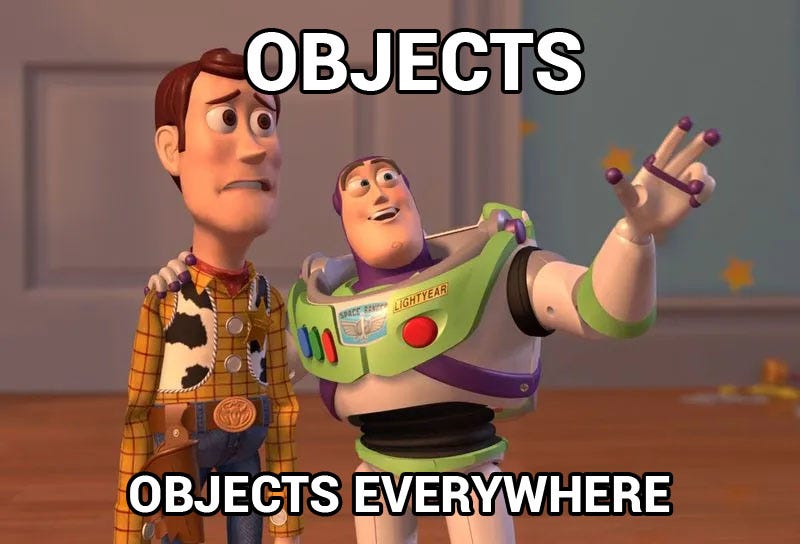
Objects. As far as the eye can see. Cast your eyeline in any direction, and what does it inevitably land upon but a parade of things. From fingertip to horizon, your everyday life is positively awash in them: the mug on your desk. The chair beneath your butt. The floor beneath that. The mountains in the distance and the sun that illuminates them every morning. Pre-packaged, pre-sliced, and utterly indifferent to the labels we slap on them. As if Reality itself was parceled out in advance by some unseen bean counter, and all you’re doing from behind that pane of glass is tallying it all up.
Except there is no bean counter. And no unseen knife doing the carving, for that matter. So what precisely are these unauthored ‘things’ that surround us? We’re not asking how your coffee cup gets manufactured - forget about ‘How It’s Made’. We’re asking what qualifies something as a ‘thing’ in the first place. And while we’re at it - why there are ‘things’ at all?
(Quick bit of housekeeping: we’ll be using ‘things’ and ‘objects’ interchangeably throughout. This is on purpose - the distinction matters in some contexts, but not here.)
What The Hell Is A ‘Thing’?
Let’s get the obvious out of the way: asking ‘what a thing is’ is an obnoxious question - exactly the kind of hair-splitting that can make philosophy feel like a useless discipline.
We’re going to ask it anyway.
Why? Because our go-to answer sucks. It might not be apparent that we even have one, since it’s not the type of explanation that announces itself with a label. You probably haven’t seen it spelled out in a book, turned into a lecture, or referenced in a meme. And unless you know what to look for, the issues it causes us are easily missed.
Much like a misaligned steering column that’s subtly pulling you off course and wearing down your tires, the effects are quiet. It won’t stop you from using a doorknob, swinging a hammer, or cooking a meal. What it does instead is leak out into the background assumptions about what the world is, who we are, and how the two relate. Trace this leak back to its source, and you’ll find a particular way of seeing that’s been passed off for Reality itself. An unintentional bait and switch that’s furnished by common sense, and worn like a comfortable pair of glasses.
So what’s the problem with a comfy pair of glasses? Nothing, so long as you know that you’re viewing the world through a particular lens that shapes what you see. And when you’re unaware that this lens even exists - much less that it’s tailored for a particular body, shaped by a particular life, and tossed into a particular time and place - it’s a recipe for bad theory, lousy self-understanding, and even worse politics.
So what’s behind the lens? Let’s do our best to state it plainly.
If you actually pinned them down, what would most people say to ‘what the hell is a thing?’ Not what things are made of (physics and chemistry). Not how they got their names (etymology). But what earns something its basic ‘thingness’ in the first place. What’s the commonsense answer?
If they don’t bolt out of the room at being pressed on something so obnoxious, a typical response might go something like this: objects have boundaries. The mug is where the mug ends and the table begins. Simple as that.

A more sophisticated answer might go like this: the mug doesn’t ‘have’ a boundary, it is its boundary - in a direct and literal way. If they’re the type to wax poetic, they might add that it’s a division that will persist until your elbow sends it tumbling to the floor, or the gods of entropy reclaim those materials, atom by atom, somewhere between now and the heat death of the universe. And if they’re a bit of a show-off: a bona fide terminus est between ‘mug’ and ‘not-mug’ that linguistics is merely downstream from.
So there it is: not a theory, but a tacit, everyday understanding that operates beneath the level of theory. ‘Things’ are the boundaries we encounter in the world. Boundaries that were already drawn up before you looked, and will persist long after you’ve looked away.
Which leaves perception with a pretty rote job that adds nothing new to the ledger - when it’s working as intended, that is. ‘Seeing’ is finding, not making - or so this story goes.
The Ghost In The Skull
And then there’s you. Throw the person behind those eyes back into the mix, and we have the last piece of that peculiar portrait we started with. Stand back and look at it. Really look at it. And what does it all add up to? A ghost in the skull, jacked into a pre-assembled world that’s been sliced up prior to your arrival. Experiencing it all from behind a one-way visor, encased within a biological chassis that it somehow controls but can’t quite touch. That’s the portrait we inherited.
Weird, right? But here’s the thing. Weird is fine. Weird we can work with. Quantum mechanics is weird. General relativity is weird. Weird can be generative: without it, we would never be surprised, never learn, never grow.
No, the issue with this portrait isn’t that it’s weird - the alternative we’ll be exploring is less familiar but no less strange. It’s that a lifetime of exposure has bled the strangeness right out of it.
And that it’s wrong.
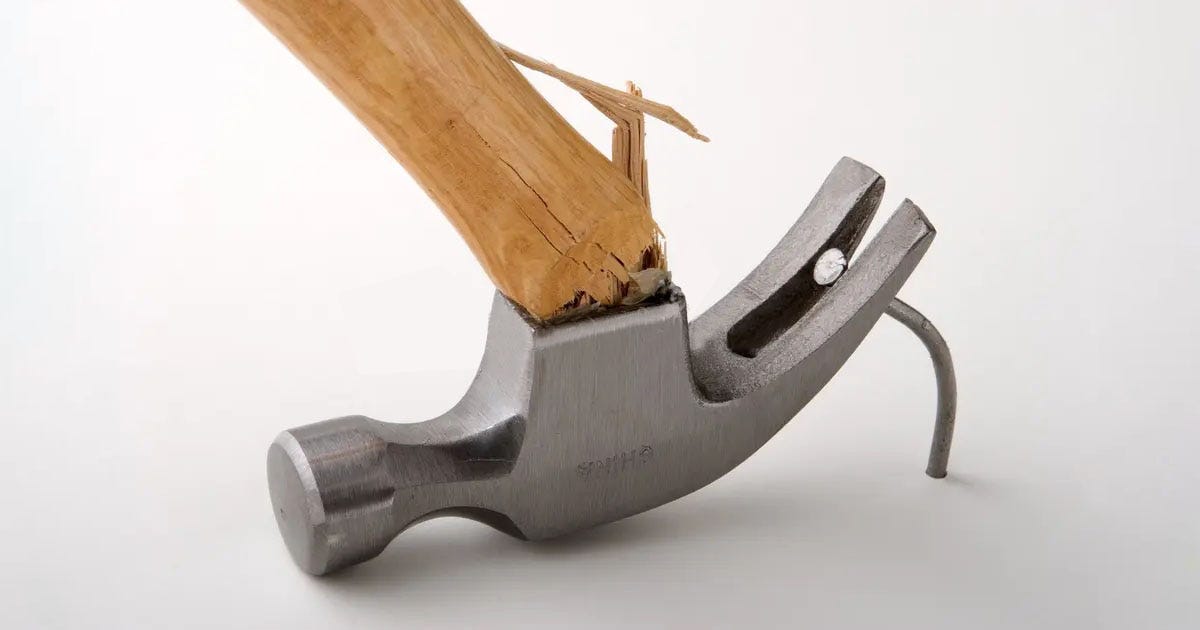
Not wrong the way a bad theory is wrong, since it works below the level of theory. It’s wrong in the way that a fish is oblivious to water. Because that detached, objects-sitting-there stance? It’s not how you normally meet the world at all. It’s what kicks in when something breaks - the perceptual equivalent of driving on a donut. Indispensable in a pinch; not meant to take you to work for months on end.
And so, without anyone intending it, we’ve spent our whole lives turning an exception into a rule. Elevating a problem-solving mode into a God’s-eye view. Constructing a folk-Reality out of broken doorknobs.
Constructing A Folk-Reality Out Of Broken Doorknobs
So how do we get from broken doorknobs to capital ‘R’ Reality? We begin with our absorption within an everyday world where doorknobs go unnoticed - until there’s a problem. It’s unexpectedly locked. The knob comes off in your hand. You attempt to finagle it open while your arms are full with groceries. Without your permission the doorknob snaps into focus as a thing - bounded, present, demanding your attention. And voilà: it exists.

The raw materials - they’ve been there the whole time. What’s changed isn’t the brass or the spindle, but how they show up for you. What those materials have become for the person with an arm full of groceries and a full bladder.
What’s happened at this moment is that the autopilot has stalled. What was once an invitation to action becomes a ‘thing’ - stubbornly sitting between you and your bathroom. And just as one asshole in a crowd of pleasant people can ruin your day, what sticks out to us isn’t the thousands of doorknobs that worked without a hitch. It’s the one that got in your way.
Notice what just happened here. The brass and spindle didn’t rearrange themselves. Nothing physically changed when you took notice of it. So how did the raw materials ‘become’ a doorknob?
What The Folk-Portrait Misses
Here’s what that folk-portrait of Reality misses, in this interaction: you are part of the context that gives the doorknob its ‘thingness’. Key word here: being ‘part’ of the context. The world brings the materials, your mind carves off what’s relevant to the task at hand.
So what is a doorknob? A meeting of mind and world. Not an inert partition waiting to be discovered, but a division that mind and world actively co-create. One that will persist while you’re fumbling with your keys, and then dissolve back into the background as you turn your attention to something else. Not poofed out of existence - remember, all the bits are still there - but out of ‘thingness.’
And it’s also not a ‘choice’ - anymore than you choose to hear your name when it’s shouted to you from across a crowded room, or decide to flinch when a ball is thrown at your face. Your mind’s contribution to this partnership isn’t optional, and our shared Reality isn’t a choose your own adventure novel where you get to ‘see’ what you please. You simply showed up to it with a particular body, life experience, and set of needs that shapes what you see, before thought ever enters into the picture.
Lest this sounds like ‘anything goes’, it doesn’t. Try seeing a doorknob as a sandwich or a wall as an open doorway, and see how far that gets you. The world is a full partner in this relationship - inviting certain divisions and resisting others. And it’s not shy about dispensing consequences when you ignore its vote.
And because both partners are contributing to this process, the result isn’t always clean. Objects can be ambiguous, contested, indeterminate. You’ve probably experienced this yourself if you’ve ever mistaken a coat on a hook for a midnight intruder, or flinched from movement in the corner of your eye that turned out to be innocuous.
But this indeterminacy can have real stakes, especially when fear or stress are doing the carving. If you’ve ever wondered how a police officer could mistake a phone for a gun, this is the mechanism. It’s not just about covering their ass. Sometimes a phone genuinely shows up as a gun for someone whose training drills into them that any encounter with the public could turn deadly in a moment. Objects are under no obligation to show up in a neutral way - we bring our expectations and biases into this partnership with the world.

And once you see that, we can start to understand why this question might have something to say about how two people can watch the same video, and ‘see’ an entirely different sequence of events.
So What Are Things? They’re Boundaries.
So what the hell are ‘things’? They’re the boundaries we’re bumping into all the time in the everyday world: where the knob ends and the doorframe begins. Common sense actually gets this right.
What it gets totally wrong is where those boundaries come from.

That folk-portrait of Reality says those boundaries were already there before you arrived on the scene. Pre-sliced, pre-assembled, and waiting to be discovered. But we just watched one emerge in real-time. A doorknob became a thing not because a boundary was found, but because it was drawn - by a person, in a situation, with somewhere to be. Remove the person, and the shared Reality that it was carved from remains - what’s missing is the doorknob.
And if that’s the case - that boundaries don’t come pre-drawn, but emerge from a meeting of mind and world - a lot of supposedly deep questions turn out to be pseudo-problems, invented by bad framing. Instead of asking ‘how minds make contact with an external world’ or ‘whether our theoretical constructs really exist’, we can formulate more useful questions. Like: what shows up, for whom, and why? But to answer them well, it’s worth going into more depth on what we put into this co-authorship with the world.
Next Time: Objects Require A Mind
Neat! I've encountered enactivism from researching for my own writing, and as I've been exploring it more, the parallels are indeed striking.